
Sugar Glider
Scientific Name: Petaurus breviceps
Name Meaning: Called “sugar glider” because they love sweet foods like sap and nectar and can “glide” through the air using the membrane between their limbs.
Size & Lifespan: 4–7 inches body length, 5–6 inch tail, 4–6 oz weight. Lifespan 10–15 years in captivity.
Native Habitat: Forests and woodlands of Australia, Tasmania, Indonesia, and Papua New Guinea.
Behaviors: Highly active, vocal, curious, bond-forming, and extremely social. Glide between trees for travel and safety.
Social or Solitary: Must be kept in groups; solitary individuals become stressed and depressed.
Activity Cycle: Nocturnal.
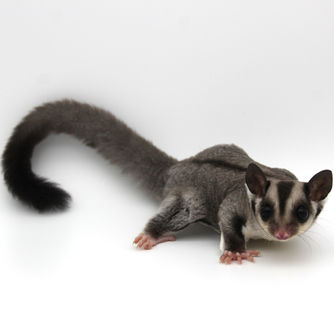
Appearance Reasoning: Large eyes for night vision, gliding membrane for moving between trees, sharp claws for climbing.
Fun Facts:
– Can glide 150+ feet.
– Communicate with chirps, barks, and crabbing.
– Have a pouch like kangaroos (they are marsupials).
Enclosure
Provide a tall, climbing-heavy enclosure. Minimum size: 24” x 24” footprint and at least 4 ft tall for a pair, bigger is better.
Use safe substrate such as paper bedding or fleece liners. Avoid dusty substrates; cypress mulch is safe but not ideal because they climb rather than dig.
Ideal temperatures 75–80°F, humidity 40–60%. They do not require UVB but can benefit from very low-level UVB indoors.
Avoid temps below 65°F. They can handle up to 85°F but prolonged heat can cause stress. Provide lots of branches, pouches, fleece hammocks, and wheels (no wire wheels).
Diet and Hydration
Sugar gliders are sap eaters and insectivores with a high need for variety.
Ideal diet includes nectar blends, protein, fruits, veggies, insects, and calcium balance.
Weekly Feeding Schedule (for adult gliders):
– Daily Evening: 2 tbsp total diet per glider
– Insects: 3–4 times per week, 2–4 gut-loaded insects per glider
– Fresh water: Always available
Staples:
– Glider-safe nectar mix (HPW/BML/Glider Complete)
– Insects: dubia roaches, mealworms, crickets, black soldier fly larvae
– Fruits: apple, melon, berries, papaya, mango
– Veggies: sweet potato, carrot, leafy greens, squash
Treats:
– Honey drops, yogurt drops (limited), small amounts of cooked egg, corn, nuts
No Feed / Toxic:
– Chocolate, garlic, onion, rhubarb, iceberg lettuce, processed human foods, avocado, fruit pits
Hydration:
Use a water bowl or bottle—bowls encourage better hydration. Offer nectar mixtures nightly.
Supplements:
Calcium with D3 depending on diet plan (BML/HPW already balanced). Avoid oversupplementation.
Diet Behaviors:
Nocturnal eating; stash food; may refuse new foods until introduced slowly. Very sensitive to poor calcium ratios—risk of hind-leg paralysis if diet is wrong.
Health
Common risks include parasites, malnutrition, hind-leg paralysis (from poor calcium), dehydration, dental disease, stress-related illness, and bacterial infections.
Stress and improper diet are the leading causes of fatal issues.
Handling
Sugar gliders bond deeply but require patience. Can get stressed with rough handling or new people.
Handle with slow, gentle movements. Best method is allowing them to climb onto you rather than grabbing.
Carry in bonding pouches to build trust. Avoid waking them during the day unless necessary—they will crab and can nip.
For shows:
They can be good for quiet, controlled, small groups but can be stressed by loud kids. Not ideal for high-energy birthday parties with many children touching them.
Use only fully bonded, confident individuals. They move quickly and can leap away if startled.
Requirements for Show Animals
– Must be extremely friendly, bonded, and tolerant
– Not messy but may urinate when nervous
– Cannot reliably do 5+ shows per day; too stressful
– Do not box for long periods; they stress easily
– Not good with heat; must stay under 85°F
Conclusion:
Sugar gliders are not ideal show animals for high-volume or high-heat environments. Best used in calm, educational demos only.